We are proud to share that IRCCS San Raffaele Roma took part in the Swiss Biotech Day 2026 in Basel, one of the leading global events in the biotechnology sector. The event gathered more than 3,000 senior life sciences professionals from 49 countries, featuring over 130 exhibitors, more than 50 thematic sessions, and 25 international delegations in the Global Village—clearly demonstrating the strength and reach of international collaboration in life sciences and innovation.
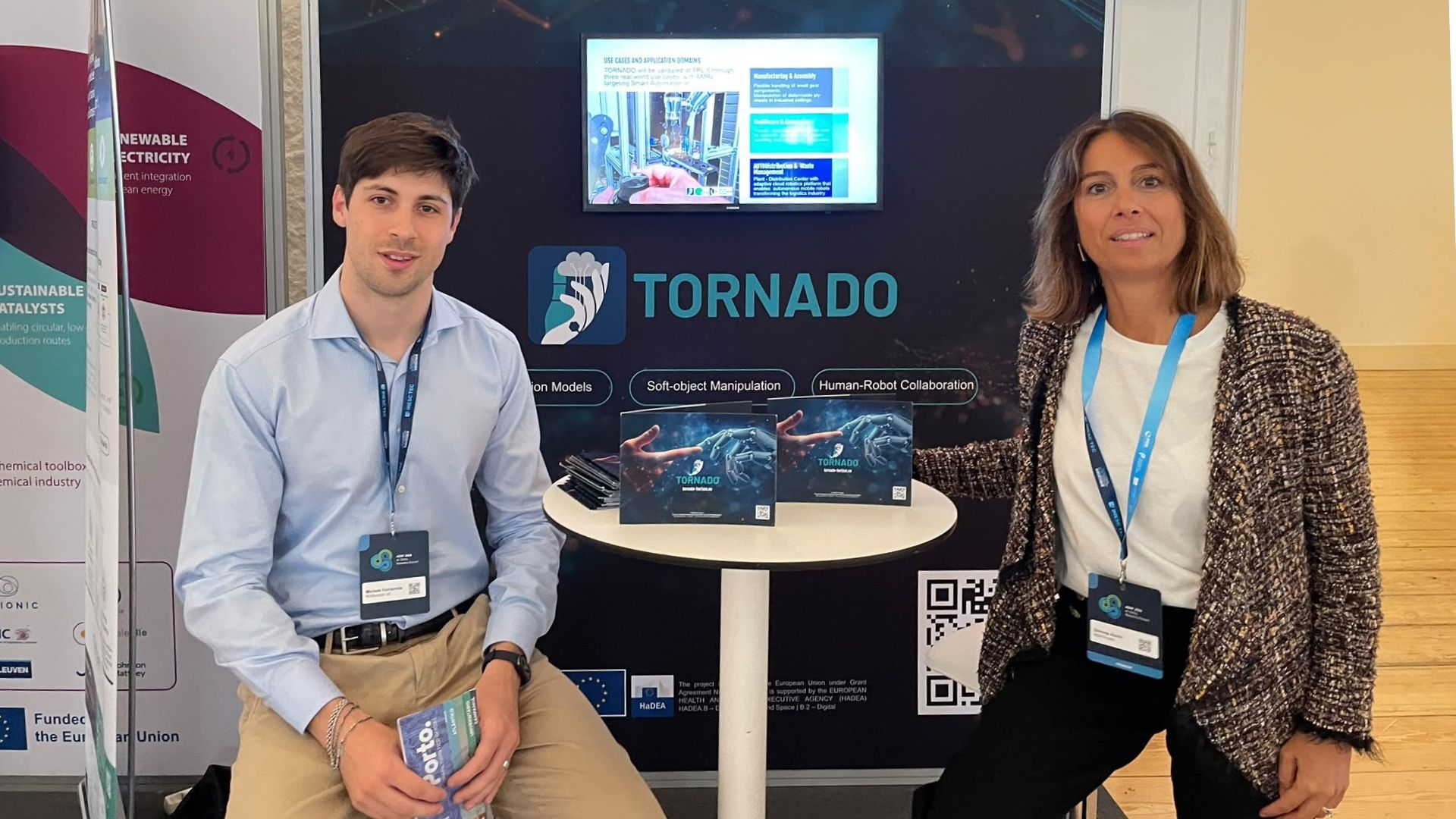
In this context, IRCCS San Raffaele represented the entire consortium of partners of the TORNADO project just as we are developing a next-generation cloud robotics platform designed to enable autonomous mobile robots (AMRs) to operate in complex, dynamic, and human-populated indoor environments. These intelligent systems will integrate advanced navigation capabilities, real-time adaptation, and the ability to manipulate small, soft, and deformable objects with high precision.
Swiss Biotech Day provided an important opportunity to p04, contributing to ongoing discussions on research, innovation, artificial intelligence, and emerging models of cross-sector collaboration.
Events of this kind play a key role in strengthening the connections between academia, industry, and healthcare institutions, fostering the exchange of ideas and accelerating the development of innovative solutions with real-world impact for patients and society.
Why this presence was important for TORNADO
The participation of IRCCS San Raffaele at Swiss Biotech Day 2026 was strategically relevant for several reasons.
First, it allowed TORNADO to position its cloud robotics vision within a high-level international ecosystem where biotechnology, artificial intelligence, and healthcare innovation increasingly intersect. This cross-disciplinary context is essential for technologies like those developed in TORNADO, which are designed for real-world environments and applications.
Second, the event provided a unique opportunity to increase the visibility of the project and its EU-funded research activities, strengthening awareness among potential stakeholders, including research institutions, industry leaders, and innovation partners.
Finally, engaging directly with the global life sciences community enabled valuable feedback and dialogue, supporting the long-term objective of translating advanced robotic technologies into practical solutions that can improve efficiency, safety, and quality in healthcare and other sensitive environments.